Features
One app for the whole picture.
Mind Matter isn't a mood tracker with extras bolted on. Every part of it writes into the same record, so your sleep, your medication, what you ate, and what you wrote at midnight can finally be read side by side.
The daily loop
Two minutes a day is enough to see something.
The app is built so the smallest possible action still produces a useful record. You don't have to journal for an hour. You have to tap how you feel.
Check in
Rate your mood, note what's driving it, and you're done. A streak counter and a consistency grid reward showing up rather than performing wellness.
Write, if you want to
The journal is there when you have more to say, with prompts for the nights the page feels blank. Entries are timestamped and searchable later.
Let it accumulate
After a couple of weeks the analytics have enough to work with — trend lines, rolling averages, and correlations between your logs and your mood.
Get it back as something readable
Insights surface patterns you'd never hold in your head. A clinician-ready report turns six weeks of logs into one page you can hand to a professional.
Quick tools
Twelve things, one tap from the home screen.
The tool row reorders itself around what you actually use, so the thing you reach for most stops being three taps away.
Journal
Free writing with optional prompts, saved privately and searchable later.
Nutrition
Log meals and see how eating patterns line up against how you felt.
Fitness
Track movement — one of the strongest and most reliable mood levers there is.
Gratitude
A deliberately small habit with a disproportionate evidence base behind it.
Check-in
Walk through what you're experiencing and get it recorded properly.
Sleep
Hours, quality, and how the night before shows up in the day after.
Cycle
Cycle tracking that connects to mood, so hormonal patterns stop being invisible.
DBT skills
Distress tolerance, emotion regulation and interpersonal effectiveness, on hand.
Meds
What you take, when you took it, and what changed after a dose adjustment.
SOS Calm
Box breathing and grounding for when reading anything longer is impossible.
Safety
Your crisis plan, written while you're steady so it exists when you're not.
Report
A clean summary of your tracked history, formatted to hand to a clinician.
Explore
Pick a part of the app.
Daily check-in
The whole daily obligation is one tap. Rate the day, optionally note what drove it, and you are done — the app is deliberately designed so the minimum viable action still produces a usable record.
- A streak counter and consistency grid that reward turning up, not performing wellness
- Milestones at 3, 7, 14, 30, 50, 100 and 365 days
- Backfill a day you missed without breaking the record
Journal
Free writing with prompts for the nights the page feels blank. Entries are timestamped, searchable, and tied to the mood you logged that day — so a bad week comes with its own explanation attached.
- Prompts when you do not know where to start
- Everything searchable later, by date or content
- Cognitive distortions detected in your own writing
Wellbeing screeners
Published, validated questionnaires used in actual clinical practice — cited to their original papers and scored the way the research defines, not approximated.
- PHQ-9, GAD-7, PCL-5, ASRS, AUDIT, OCI-R, EPDS and eleven more
- Scored per the source paper, including per-item thresholds where that is how the instrument works
- Tracked over time, so you see a direction rather than one number
Guided programs
Multi-session tracks built on cognitive behavioural and dialectical behaviour therapy — the two most evidence-backed frameworks in modern mental health care.
- Covering depression, anxiety, ADHD and trauma
- Thought records you complete when the thought actually shows up
- A treatment plan tracking what you tried and what genuinely helped
Trends & insights
Once there are a few weeks of data, the app stops describing your mood and starts finding reasons for it — correlations drawn from your own logs rather than generic advice.
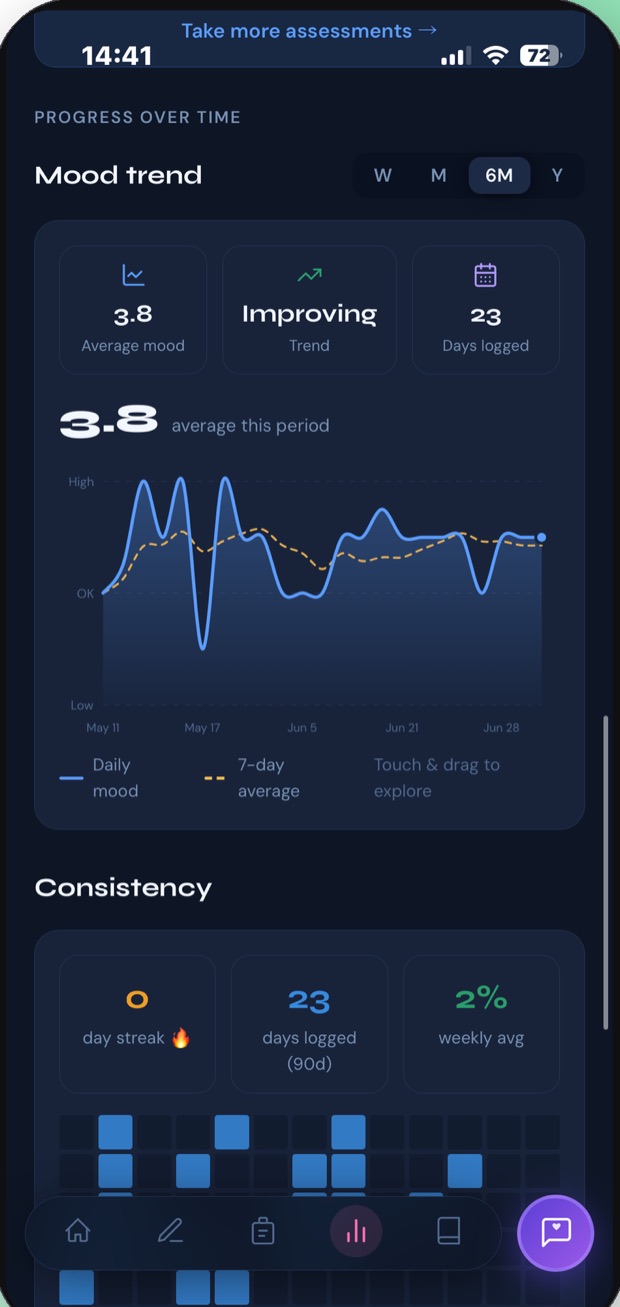
- Mood over weeks, months and years with rolling averages
- What actually moves your baseline: sleep, movement, medication, cycle
- A yearly retrospective of how far the line really moved
Crisis tools
Most wellness apps are designed for the version of you that is already coping. The hardest moments need fewer words, bigger buttons, and a plan you wrote before you needed it.
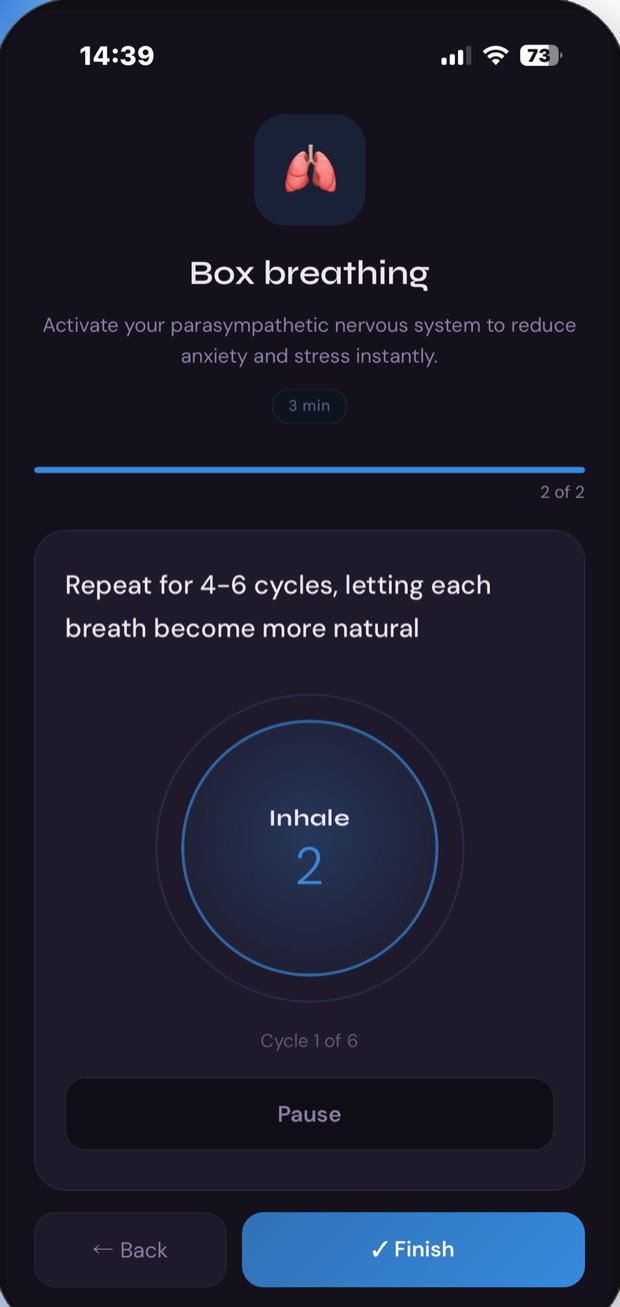
- SOS Calm — guided box breathing and grounding, no reading required
- A crisis plan written while you are steady: warning signs, people, what helps
- The right crisis line for the country you are in
Wellbeing check-ins
Eighteen real screeners, not quizzes someone made up.
Every questionnaire in Mind Matter is a published, validated instrument used in actual clinical practice — cited to its original paper, scored the way the research defines, and tracked over time so you can see a direction rather than a single number.
Self-guided programs
Structured therapy work, at your own pace.
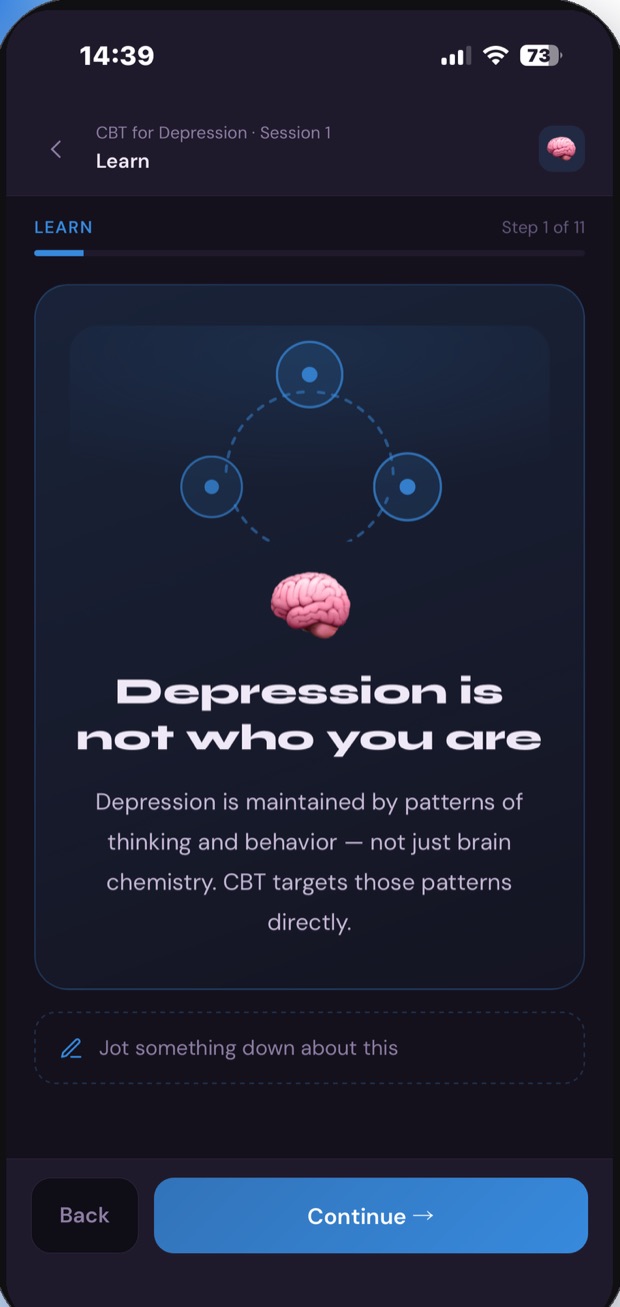
Multi-session tracks built on cognitive behavioural and dialectical behaviour therapy principles — the two most evidence-backed frameworks in modern mental health care — covering depression, anxiety, ADHD and trauma.
- Sessions you work through in order, with progress saved
- Thought records that catch distortions in your own writing
- A treatment plan that tracks what you tried and what actually worked
- No appointment, no waiting list, no scheduling
Trends & insights
The part you could never do in your head.
Mood over time
Weekly, monthly, six-month and yearly views with a rolling average laid over daily noise, so a bad Tuesday stops looking like a trend.
Correlations
What actually moves your baseline — sleep, movement, medication changes, food, cycle phase — surfaced from your own logs rather than assumed.
Pattern spotting
Cognitive distortions detected in your own writing, and recurring themes pulled from across sessions you'd long forgotten.
Consistency
Streaks and a logging heatmap that make the habit visible, with milestones worth stopping for at 3, 7, 30 and 100 days.
Year in review
A yearly retrospective of where you were, what changed, and how far the line actually moved.
Apple Health
Optionally pull sleep and step data in, read-only, so the picture fills itself in without more typing from you.
When it gets bad
Built for your worst night, not just your average one.
Most wellness apps are designed for the version of you that's already doing okay. The hardest moments need something different — fewer words, bigger buttons, and a plan you wrote before you needed it.
- SOS Calm — guided box breathing and grounding, no reading required
- Crisis plan — your warning signs, your people, what helps, written in advance
- Local helplines — the right crisis number for the country you're in
- DBT distress tolerance — skills for riding out the peak without making it worse
See it on your own data.
All of it is unlocked from the first minute of the free trial — nothing held back while you decide whether it's for you.